In decision theory, risk adversity is a terminal goal
In decision theory, risk adversity is represented by concavity in the utility function. Concave functions bend downwards, so a straight line drawn between any two points would lie below the function line, and averaging any two function values by any weight would have a smaller value than the function at the averaged position.
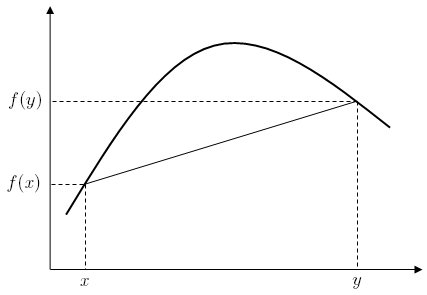
Px*f(x)+Py*f(y) < f(Px*x+Py*y)
For a given average outcome, the expected utility is higher if there are fewer possible outcomes. Maximizing expected utility then makes the agent prefer a smaller variance in outcomes. This is how decision theory generates risk adverse behavior.
Presented in this way, the desire to reduce variance is fundamental, an ends in itself, and not subject to justification.
Risk adversity seems to be instrumental in reality
When I consider a risky choice, however, I don't undergo anything like the process of utility maximization. If I am highly uncertain, I may
- delay the decision and acquire more information
- avoid the choice to avoid complicating the context of future decisions
- avoid the choice because of the fear that uncertainty makes me susceptible to fraud, since other agents have freedom in the uncertain space.
These reasons all point to uncertainty as an indicator of incomplete information, and as a cue to spend more on information or a chance to avoid future information cost, something a priori excluded if you assume information costs to be zero, as does canonical economic theory.
Presented in this way, the desire to reduce uncertainty is instrumental, a means of bettering the expected outcome, not a goal in itself.
Conclusion
Risk adversity's relationship to the management of ignorance cannot be denied. Characterizing risk adversity as the maximization of concave utility functions misses this point. Exogeny is useful for compartmentalizing and communicating theories, but in making ignorance exogenous you restrict an agent from choosing to learn more or to avoid the cost of future learning. In the presence of this restriction, the model will not display a realistic reaction to risk.
Related
1 comment
That's why all PhD graduates should just stay in academia or a place without internet!